



-The journal is recommended by the Ministry of education of Russia and included in the international database SCOPUS.
Iberoamerica 2024 №2
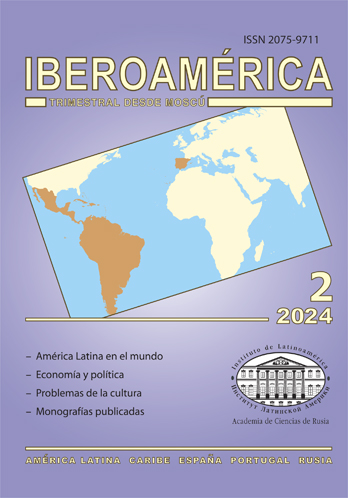
This issue of the journal presented to the reader includes four blocks. The first one is dedicated to the place of Latin America in the modern world. The article by Chilean researcher Juan Rivas Maldonado analyzes the features of geographical and political concepts of development in Latin America throughout its history. Ksenia A. Konovalova and Anton S. Andreev examine the views and approaches of Uruguayan politicians and scientists to the concept of multipolar world, paying attention to both the frequency of reference to this category and the contexts in connection with which it arises. Denis A. Kuznetsov and Ksenia M. Tabarintseva explore the problems of science diplomacy in the region, note positive trends and challenges associated with insufficient investment, weak cooperation between scientists and politicians, and give their recommendations for improving the situation.
The authors of the second block consider current problems of economics and politics. The article by Natalia P. Kononkova and Diana A. Mikhailenko explores the problems of sharing economy, the path of its evolution and its trends at the present stage, so as identify drivers and limitations, common and special features in the development of this type of economy in Russia and Latin America. Arina A. Andreeva assesses the role of the Spanish army in ensuring the internal and international security of Spain and underlines the unique position of this country, which actively participates in NATO military and humanitarian missions, while defense spending is at a record low. In the changed geopolitical situation, antagonism arose between the political guidelines of Madrid and the demands of the alliance partners.
The third block is devoted to cultural issues. The article by Lidia W. Rostotskaya examines the unique authorial style of famous Portuguese film directors, whose work resists the processes of unification, continuously occurring in modern culture and art. The article by Natalia A. Sheleshneva-Solodovnikova, also dedicated to Portuguese culture, pays attention to the unique style of architects of the 21st century, who, in the pursuit of new solutions, combine global achievements and a strong national identity. Liudmila L. Kleshchenko analyzed images of the 1970s Chilean Revolution in the mass culture of the Soviet Union, using as sourses films, documentaries, songs, propaganda posters, and cartoons, and showed how events in Chile were used for political mobilization during the Cold War.
The editors of the journal continue to introduce readers to new books published in Russia. The fourth section of the issue contains a review by Alexandra A. Kurakina-Damir of Sergei M. Khenkin’s monograph “Spain. Modern Unstable Society" and Marcelo Bezerra's opinion on the collective research "Antarctica: Global Agenda and Interests of Latin American States", prepared by Russian specialists from various academic institutions and edited by the head of the Center for Political Studies of the Institute of Latinamerican Studies of the Russian Academy of Sciences, Nadezhda Y. Kudeyarova.
IBEROAMÉRICA
2024, no.2 (April – June)
Content
|
|
LATIN AMERICA IN THE WORLD
|
|
ECONOMY AND POLICY
Natalia P. Kononkova, Diana A. Mikhaylenko. Sharing Economy in Russia and Latin America
Arina A. Andreeva. Functions of the Spanish Army in Domestic and Foreign Policy
|
|
PROBLEMS OF CULTURE
Lidia W. Rostotskaya. Features of the Esthetics of Portuguese Cinema
Natalia A. Sheleshneva-Solodovnikova. The Contemporary Architecture of Portugal
|
|
PUBLISHED MONOGRAPHS
Alexandra A. Kurakina-Damir. Spain in Times of a Stable Instability
Marcelo Bezerra. Latin American Countries and the Antarctic Question
Текущий номер
Current issue
Último número
Основные темы
Main topics
Temas principales
- Latin American Infrastructure
- Climate Changes and Ecology
- Domestic and Foreign Policy
- Problems of Culture
ринц
ринц
ринц
INDEXED



Полнотекстовая электронная версия находится в открытом доступе с 2010 г.
По годам
The full texts since 2010 are freely accessible
Years
Textos íntegros desde 2010 están en libre acceso
Años